

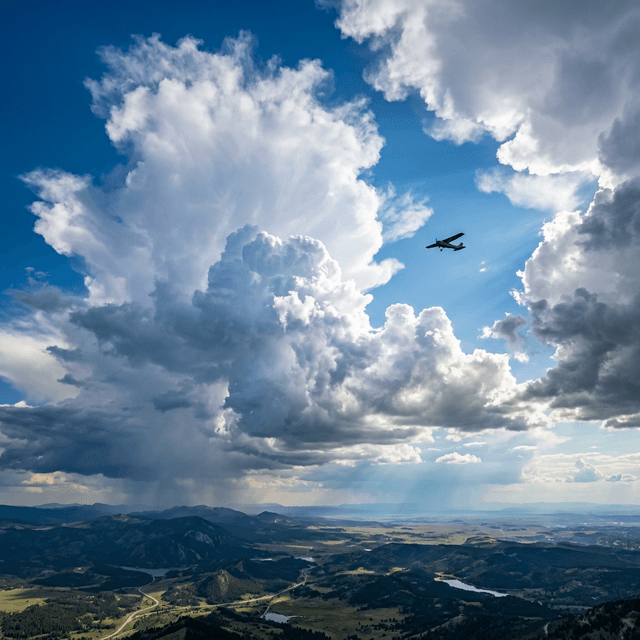
Meteorology is undoubtedly one of the subjects that inspires the most respect and fear among Private Pilot License (PPL) students. It requires not only memorizing abstract concepts but also understanding how various atmospheric forces interact.
At Pilot One, we analyze thousands of student answers and have detected clear patterns. Below, we show you the most typical mistakes in PPL meteorology questions and how you can avoid them.
1. Confusing QFE, QNH, and QNE
This is the king of mistakes in exams. Altimetry is vital for aviation, and EASA always includes trick questions about altimeter settings.
- QFE: Height above Field Elevation. If you set it on the ground, the altimeter reads zero.
- QNH: Altitude above mean sea level. If you set it on the ground, the altimeter reads the airport's elevation.
- QNE: Standard setting (1013.25 hPa). Used above the transition altitude to measure Flight Levels (FL).
The typical mistake: Calculating obstacle clearance using QFE instead of QNH, or failing to add terrain elevation when calculating a cloud base. Pro Tip: Always draw a quick sketch before answering these mathematical questions.
2. Thermal Inversions and Visibility
Many students associate "stable air" with "good weather." Careful! Atmospheric stability simply means the absence of vertical air movement.
The typical mistake: Believing that a thermal inversion (where temperature increases with altitude) provides excellent VFR flying conditions. In reality, inversions trap dust, smoke, and pollution close to the ground, drastically worsening visibility. If you see "thermal inversion" in a question, quickly look for answers related to haze, fog, or poor surface visibility.
3. Misunderstanding Fronts (Cold vs. Warm)
EASA loves asking you to identify the types of clouds associated with a front. The common mistake is mixing up the characteristics of both.
- Cold Front: Moves fast, abruptly pushes warm air upwards. Causes clouds of vertical development (Cumulonimbus), heavy showers, turbulence, and good visibility after it passes.
- Warm Front: Moves slowly, gradually slides over the colder air mass. Causes a long sequence of stratiform clouds (Cirrus, Altostratus, Nimbostratus), continuous rain, poor visibility, and freezing rain.
Don't blindly memorize; visualize the wedge of air. The cold front is a violent "bulldozer," while the warm front is a gentle "ramp."
4. Differentiating Between Types of Fog
Another star category in the question bank. Why did fog form last night? You need to know the subtle difference between Radiation Fog and Advection Fog.
- Typical mistake: Thinking that radiation fog occurs with strong winds.
- The reality: Radiation fog requires clear skies, nocturnal cooling, and very light wind (2-5 knots). If the wind is strong, stratus clouds form instead of fog. Conversely, advection fog occurs when warm, moist air moves over a cold surface (like sea air moving inland in winter), and it can sustain moderate winds.
5. Misreading the METAR / TAF
Decoding a METAR is easy until specific information groups appear.
The RVR code: If you see R24/0800U, the common mistake is thinking the 'U' stands for Unidentified. It actually means Upward (the visibility trend is improving). 'D' is Downward (worsening), and 'N' is No change.
The CAVOK code: It doesn't mean there are absolutely no clouds. It means "Ceiling And Visibility OK": Visibility of 10km or more, no clouds below 5,000 feet (or the MSA, whichever is higher), and no Cumulonimbus (CB) or significant weather phenomena. There can be an overcast ceiling at 6,000 feet and it can still be CAVOK!
Conclusion
The trick to passing Meteorology in the PPL is not blindly doing tests but understanding the why behind each phenomenon. In the Pilot One app, every Meteorology question includes a detailed, step-by-step explanation so you never fall into the classic EASA traps again.
Clear skies, and good luck with your studies!