

Pilot One
EASA PPL Study Plan with AI: How Student Pilots Should Prepare in 2026

EASA PPL Study Plan with AI: How Student Pilots Should Prepare in 2026
AI can make PPL theory study faster, clearer, and more personalized. It can also create false confidence if you use it as a shortcut. The safest approach is simple: use AI to explain, organize, and review, but use official theory, reliable question banks, instructor guidance, and mock exams to prove you are ready.
Quick Answer
The best EASA PPL study plan in 2026 combines three things: structured theory reading, topic-by-topic question practice, and AI-assisted explanations for mistakes. Student pilots should aim to score consistently above 85% in mock exams before booking the real exam, even though the pass mark is usually 75%.
Why PPL Theory Feels Hard
PPL students are not just memorizing facts. They are learning how aviation systems interact under pressure:
- Weather affects performance, navigation, alternates, and decision-making.
- Air law changes how you read charts, airspace, and procedures.
- Human performance affects workload, fatigue, and risk.
- Aircraft technical knowledge changes how you interpret symptoms in flight.
That is why pure memorization is fragile. A small change in wording can expose a gap in understanding.
Where AI Helps Student Pilots
AI is useful when it acts like a patient study assistant:
- Explaining why an answer is wrong.
- Turning a dense textbook section into a checklist.
- Creating short revision prompts.
- Comparing similar concepts, such as QNH, QFE, and standard pressure.
- Building a weekly plan around available study hours.
AI is not a replacement for flight instructors, official material, or validated exam preparation. Treat it as a learning amplifier.
The 6-Step EASA PPL Study System
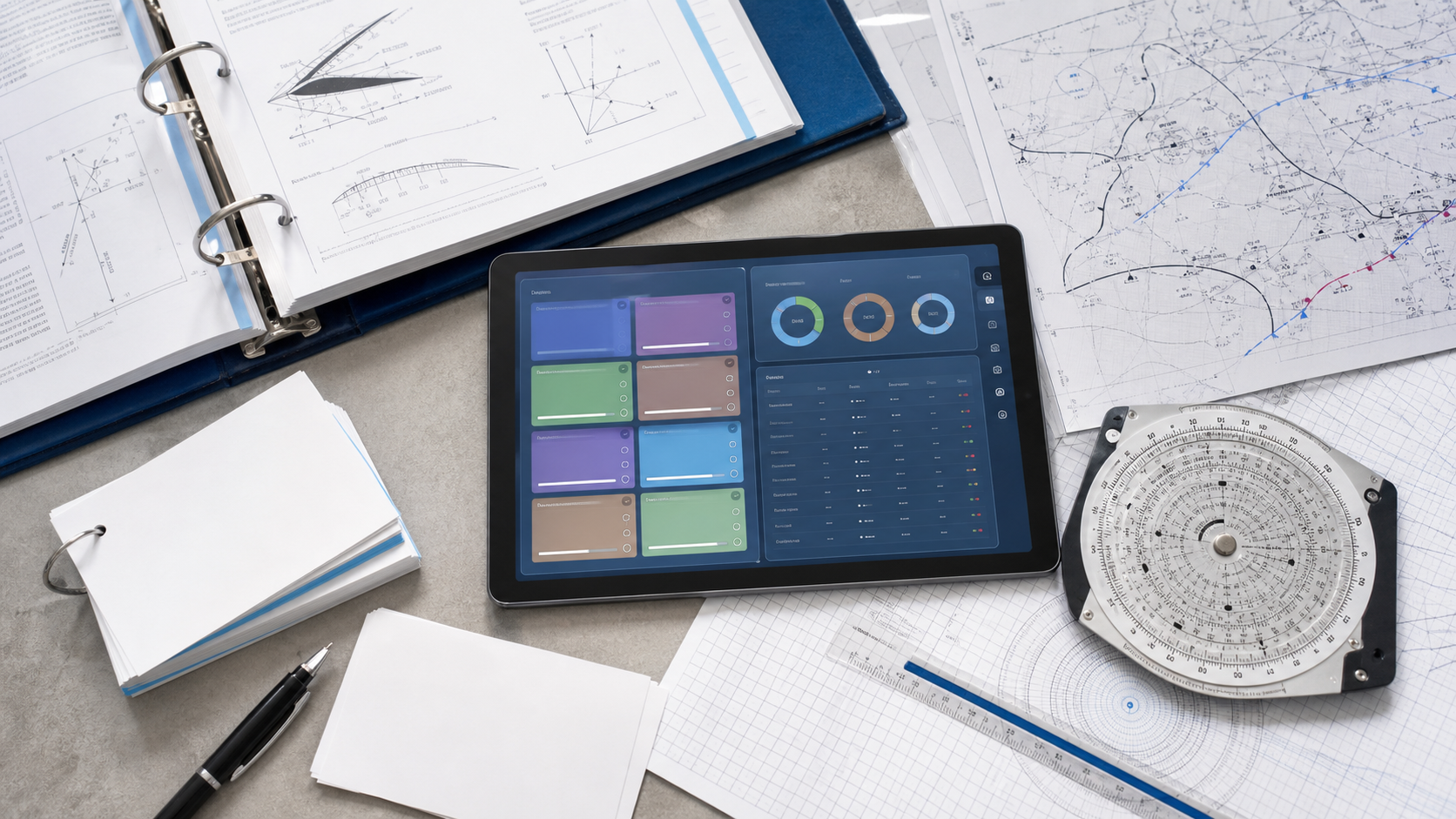
1. Start with the Exam Map
Before studying, list the subjects you need to pass. Most PPL theory programs include areas such as Air Law, Human Performance, Meteorology, Communications, Navigation, Operational Procedures, Principles of Flight, Aircraft General Knowledge, and Flight Performance and Planning.
Your first goal is not to master everything. Your first goal is to know the map.
2. Read Before You Test
Do not open a full question bank on day one. Read the chapter first, then test by topic. This prevents pattern memorization and helps you build mental models.
Use AI after reading, not before. Ask it to explain difficult ideas in plain language, then verify with your course material.
3. Practice by Topic
Topic practice is where progress becomes measurable. For every wrong answer, write down:
- The subject.
- The concept you missed.
- Why the correct answer is correct.
- What trap made the wrong answer tempting.
This mistake log becomes your personal revision syllabus.
4. Use AI to Explain Mistakes
A strong prompt is specific:
Explain this PPL meteorology question like I am a student pilot. Show the concept, the common trap, and a memory aid. Do not invent regulations.
The phrase "do not invent regulations" matters. Aviation study needs precision.
5. Move to Mock Exams
Once topic scores are strong, switch to timed mock exams. Simulate the real environment:
- No notes.
- No pausing.
- No checking answers mid-test.
- Review mistakes only after finishing.
If you are scoring below 85%, keep studying before booking the official exam.
6. Review Like a Pilot
Pilots do not only ask, "What is the answer?" They ask, "What would I do with this information in flight?"
For example:
- A pressure question becomes an altimetry decision.
- A cloud question becomes a VFR planning decision.
- A mass and balance question becomes a go/no-go decision.
- A radio phraseology question becomes a workload and clarity issue.
4-Week PPL Subject Plan
Week 1: Understand
Read the material, watch explanations, and build summaries. Keep sessions short but consistent.
Week 2: Practice
Work through topic questions. Start your mistake log. Use AI only to clarify concepts you have already tried to understand.
Week 3: Repair Weak Areas
Identify the three topics causing the most errors. Re-read, ask for explanations, and create mini-checklists.
Week 4: Mock Exams
Run timed mocks until scores are consistently above your safety margin. If performance is unstable, delay the exam and protect your confidence.
Best Subjects to Study Together
Some PPL subjects reinforce each other:
- Meteorology + Navigation: weather changes routes, alternates, and timing.
- Air Law + Operational Procedures: rules become decisions.
- Aircraft General Knowledge + Principles of Flight: systems and aerodynamics explain aircraft behavior.
- Human Performance + Flight Performance: workload, fatigue, and planning margins are connected.
Common Mistakes with AI Study
Mistake 1: Asking AI for Final Answers Only
This trains recognition, not understanding. Ask for the reasoning, the concept, and a similar example.
Mistake 2: Trusting AI on Regulations Without Verification
Regulatory wording matters. Always verify with your approved training material or instructor.
Mistake 3: Studying Without Timed Practice
You can understand a topic and still fail under time pressure. Mock exams are part of the skill.
Mistake 4: Ignoring the Mistake Log
Your mistakes reveal the highest-return study areas. Do not hide from them.
How Pilot One Fits In
Pilot One is designed around how student pilots actually learn: structured practice, aviation context, and progress feedback. The goal is not to replace your instructor. The goal is to help you arrive at lessons and exams better prepared.
Use Pilot One alongside your school material to practice questions, identify weak areas, and build confidence before exam day.
FAQ
Can AI help me pass EASA PPL theory?
Yes, if you use it for explanations, planning, and revision. It should not replace approved course material, instructor guidance, or validated question practice.
What score should I aim for before booking the real PPL exam?
A practical target is consistent mock exam scores above 85%. This gives you margin above the usual 75% pass mark.
Which PPL subject should I study first?
Start with a subject that builds broad context, such as Air Law or Human Performance, then move into Meteorology and Navigation once your study rhythm is stable.
Is memorizing question banks enough?
No. Memorization can fail when wording changes. Use question banks to test understanding, not to replace it.
Final Thought
AI will not make you a pilot. But used well, it can make every study session sharper. The winning formula is disciplined: read, practice, review mistakes, ask better questions, and prove readiness with mock exams.